Call020 4620 1478 Emailinfo@woolwichminibushire.co.uk Quote within the hour

Minibus & coach hire · Woolwich SE18 · Royal Borough of Greenwich

Minibus hire in Woolwich, where the river decides the route

The Royal Arsenal, Woolwich Works, General Gordon Square and the ferry approach. Eight to seventy seats with a driver, quoted within the hour.

  • A 16-seater gets in where a full coach cannot. Powis Street is closed to cars and buses-only through the middle, Beresford Square is pedestrian, and the Arsenal’s own No. 1 Street is a footway. That is why most Woolwich work is minibus work.
  • The northbound Blackwall Tunnel is 4 metres. A 53-seater at 3.9 m goes through it. Our 70-seat double-decker at 4.4 m does not, and gets the free ferry, the Silvertown Tunnel or the A2 — worked out before you book, not on the day.
  • LEZ and ULEZ compliant. Woolwich is inside Greater London, so both zones reach it. No charge is passed on to you.
Talk to a person 020 4620 1478

Get a price

Two short steps. No obligation, and no card details ever.

1. The journey2. How to reach you
Your journey
One way or return?
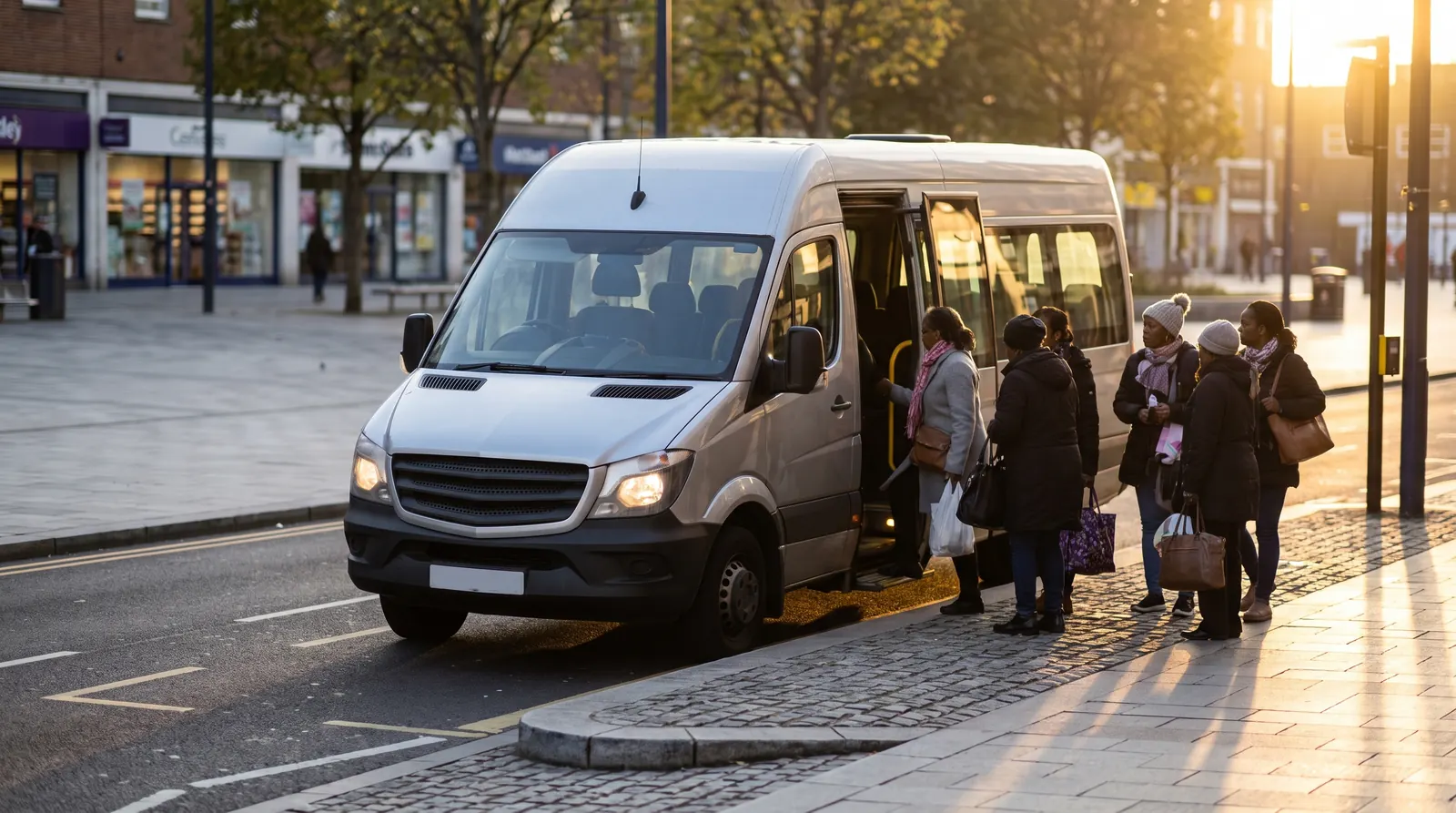
A silver-grey 16-seat minibus at the kerb beside General Gordon Square in Woolwich in late afternoon sun, its passenger door open and a group of women in going-out clothes boarding with bags.
The road beside General Gordon Square. The square itself is paved and closed to traffic, so the vehicle waits on the carriageway alongside it and the group walks the last thirty seconds.
The list

Where we take groups around Woolwich, by where the place actually is

Not a distance ranking. Woolwich is a town of three separate geographies — the flat centre, the riverside, and the hill behind it — and which one you are going to changes the vehicle more than the mileage does. Distances are straight-line from General Gordon Square, and the code underneath each one is what to give a driver.

Walking distance of the square Flat, dense, and mostly closed to traffic. Minibus country.
General Gordon Square The paved public square beside Woolwich Arsenal station, relandscaped from 2011 with a water feature. It is a square, not a road — the pick-up is Wellington Street or Thomas Street alongside it. town centreSE18 6HQ
Beresford Square The pedestrianised market square under the old Arsenal gatehouse, and the heart of the town for two centuries. Set-down is on Plumstead Road; the group walks in. 0.2 kmSE18 6AR
Royal Arsenal & Dial Arch Square The old munitions quarter — a gun yard from the 1540s, named the Royal Arsenal by George III in 1805, closed in 1994, now housing, bars and the Elizabeth line. Woolwich is the only Elizabeth line station that opens onto a public square. 0.3 kmSE18 6GH
Powis Street The Victorian and Edwardian shopping street. Closed to general traffic — the middle of it is buses only — so no group is ever picked up on it, whatever the postcode on the ticket says. 0.3 kmSE18 6LU
Woolwich Works The arts centre in five listed Royal Arsenal buildings, opened 23 September 2021 and run by the Woolwich Creative District Trust, a registered charity. The Fireworks auditorium seats about 1,200 and the Workers’ Yard courtyard up to 600 — a full coach is a small slice of either. 0.5 kmSE18 6HD
Royal Artillery Barracks Built 1776–1802 by James Wyatt, with the longest façade in London along the north side of Woolwich Common. Still an army site — you look at it, you do not walk in. 1.2 kmSE18 4BQ
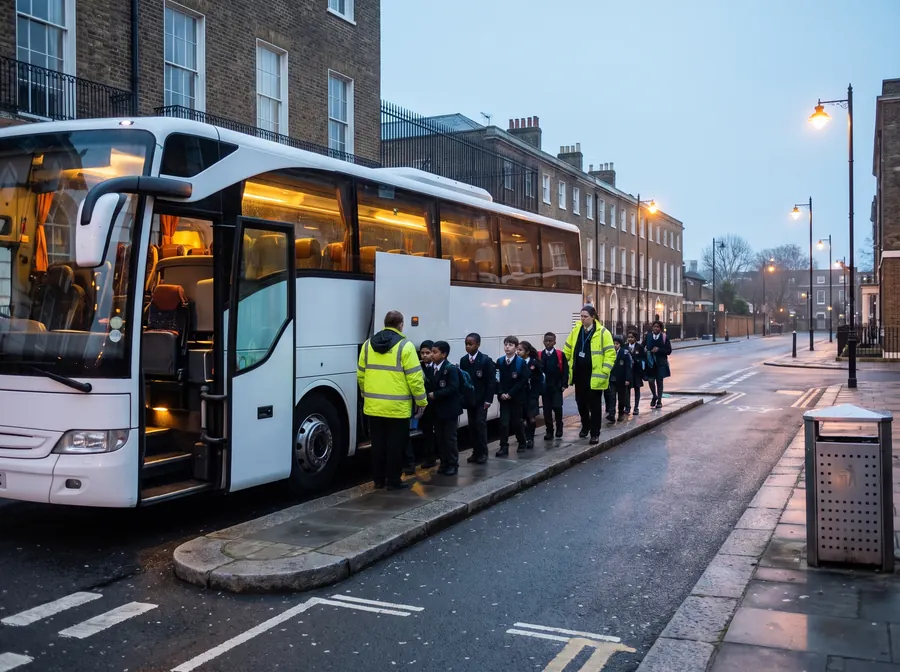
A white touring coach at the kerb outside the Royal Arsenal in Woolwich before sunrise, street lamps still lit, a line of school children in uniform boarding while two teachers count them on, long Georgian brick munitions buildings behind iron railings.
The Arsenal at a school-trip departure time A full coach sits comfortably on Arsenal Way at six in the morning, which is exactly when school groups leave. The same kerb at eleven on a Saturday is a different proposition altogether — which makes it a booking decision rather than a driving one.

What actually changed here in 2022

Woolwich got its Elizabeth line station on 24 May 2022, in the Royal Arsenal rather than beside the older Woolwich Arsenal station. It matters to a coach operator for an unglamorous reason: a great many groups now arrive in Woolwich by train and want a vehicle only for the outward leg, or only for the way home. Tell us if that is you — a one-way job is priced differently from a return, and we would rather quote the trip you are actually taking.

The Arsenal is also where the town’s museum used to be, and no longer is. That is covered further down, honestly.

Along the river Wide roads, industrial estates, and the crossings.
Woolwich Ferry, south pier Free, run by TfL, and the crossing that will take the 4.4 m double-decker. 05:00–21:00, every fifteen minutes, seven days, two boats. Published maximum vehicle height 4.7 m, width 3.5 m. 0.7 kmoff Woolwich Church St
Woolwich foot tunnel The 1912 rotunda entrance beside the ferry. Pedestrians only — useful when a group wants to cross on foot and the vehicle meets them on the other side. 0.8 kmSE18 6DX
Thames Barrier Information Centre 1 Unity Way, Charlton. The barrier spans 520 m, protects 125 square kilometres of London and has closed 221 times for flood defence since 1982. The Information Centre opens Saturdays only, 4 April to 31 October 2026, 10.30 to 15.30 — adults £6.00, family ticket £16.00. Plan the coach round the Saturday. 1.9 kmSE18 5NJ
Maryon Park & Maryon Wilson Park Two linked parks on the Charlton slope above the riverside. The second has a fallow deer enclosure and a farm-animal park, with free ranger-led tours on Wednesdays. Roadside set-down; there is no coach park. 1.7 kmSE7 8HB
The O2 & Greenwich Peninsula Straight along the A206. The nearest big arena to Woolwich, and the single most common late-night pick-up we run from this town. 4.6 kmSE10 0DX
Old Royal Naval College & Greenwich Park Maritime Greenwich, about three and a half miles west. The obvious half day, and the one where the set-down point is worth agreeing in advance rather than improvised. 5.4 kmSE10 9HU
Up the hill Shooter’s Hill, Plumstead and Eltham. Narrow lanes, real gradients.
Woolwich Common Open grassland immediately south of the town, in front of the barracks façade. Flat, open, and easy to set a group down beside on Ha-Ha Road or Repository Road. 1.7 kmSE18 4HB
Plumstead Common A second common, east of the first, on the ridge above Plumstead. Residential approach roads — comfortable in a 16-seater, awkward in a 53. 1.4 kmPlumstead SE18
Oxleas Wood & Oxleas Meadow A Site of Special Scientific Interest of about 77 hectares, parts of it at least eight thousand years old, with a café at the top of the meadow and a view east over Kent. The car park is small; a coach is set down at the road. 2.6 kmSE18 3JA
Severndroog Castle, Castle Wood A Gothic tower of 1784, raised in memory of Sir William James, standing in ancient woodland 132 metres above sea level. Tea room Thursday to Sunday, 9am–3.30pm; the viewing platform opens Sunday only, 10am–3.30pm. Adults £5.00, children £3.50. 2.7 kmSE18 3RT
Charlton House One of the best-preserved Jacobean houses in England, 1607–1612, run by the Royal Greenwich Heritage Trust. Free entry, but the Historic Halls open weekdays 9.30–15.30 and Saturdays 9.30–15.00 and are closed on Sundays; the rest of the house is open only for events and hires. Guided tours every Friday, May to October. 2.4 kmSE7 8RE
Lesnes Abbey Woods Abbey ruins founded in 1178, a scheduled ancient monument, in 88 hectares of woodland at Abbey Wood. Technically over the line in the London Borough of Bexley, and a genuinely different day out from anything in the town. 4.6 kmAbbey Wood SE2
Eltham Palace & Gardens English Heritage. A medieval royal palace with a 1930s Art Deco house grafted onto it. Open daily 10am–5pm, last entry 4.30pm, and the only place on this list that publishes proper coach terms — quoted further down. 5.0 kmSE9 5NP

Two things in Woolwich that people still ask us to drive them to

Firepower, the Royal Artillery Museum, is gone. The collection was at the Rotunda on Woolwich Common from 1820, moved into the Royal Arsenal as Firepower in 2001, and closed in 2016. The museum’s own account is that the collection “was moved into storage in Wiltshire, while plans were developed for a new museum close to Larkhill”. There is nothing in Woolwich to visit.

The Greenwich Heritage Centre is also not there. It left the Royal Arsenal in July 2018 and the borough has had no walk-in local museum since. We mention both because we have been asked to quote for school trips to buildings that have been empty for years.

What people hire us for

Half of Woolwich’s coach work exists because of the river

The other half exists because the centre is too tight for a big vehicle. Those two facts between them explain nearly every job we run out of SE18.

Because of the crossings

Getting a group to the north bank

The north bank is a few hundred metres away and a long way round by road. ExCeL, London City Airport and the Royal Docks are all on it. There are three driveable crossings within reach, they have different rules, and picking the wrong one costs an hour.

Evenings at Woolwich Works and the O2

The ferry timetable ends around 21:00. A group that crosses to a show and expects to come back the same way after the curtain does not get to. We plan the return leg round the tunnels from the start.

Riverside and barrier trips

The Thames Barrier, Maryon Park and the Charlton riverside make a genuine half day. The Information Centre’s season and Saturday-only opening decide the date, not the coach.

Because of the town

School trips out of SE18 and SE28

DBS-checked drivers, seatbelts throughout, risk assessments on request. Most Woolwich and Thamesmead school gates are far more comfortable with a 16 or a 33 than with a 53.

Airport transfers

London City is the closest airport to Woolwich by some margin. Gatwick is down the A2 and round the M25, Heathrow the long way west. Luggage for the whole group in one hold.

Weddings, funerals and the hill

Shuttles between church, crematorium and reception. The lanes around Shooter’s Hill and Plumstead Common are the reason these are usually two minibuses rather than one coach.

The practical bit

Where a vehicle can actually pick up in Woolwich

The centre of Woolwich is a pedestrian centre with main roads around the edge of it. We checked each street rather than guessing, and the pattern is stark. Powis Street is signed closed to motor vehicles for most of its length, with the middle section buses only. Hare Street is the same. No. 1 Street, the address of Woolwich Works, is a pedestrian street with private access only. Major Draper Street is pedestrian. Beresford Square is a pedestrianised market square, and General Gordon Square and Dial Arch Square are squares rather than roads at all.

That is nearly every address a group would naturally give you, and not one of them takes a vehicle. So the pick-up is always a nearby road, and which road depends on the size of what is coming. A 16-seat minibus can wait on a short residential street and turn at the end of it. A 12-metre coach needs three streets to do the same thing, which is why on a lot of Woolwich jobs two minibuses beat one coach on time as well as on access.

What we actually use

  • Wellington Street and Thomas Street — the roads that frame General Gordon Square. The default for anything meeting at the square or either station.
  • Plumstead Road (A206) — for Beresford Square and the market end of town, with the group walking out of the square rather than the vehicle going into it.
  • Arsenal Way and Duke of Wellington Avenue — the driveable roads inside the Royal Arsenal, for Woolwich Works and Dial Arch. Comfortable early or late, awkward mid-afternoon on a weekend.
  • Woolwich Church Street (A206) — wide, fast and the approach to the ferry. The one place in Woolwich where a 53-seater is genuinely easy.
  • Ha-Ha Road and Repository Road — across Woolwich Common, for the barracks side and anything with a big outdoor group.

The one honest warning about the ferry approach

Woolwich Church Street is easy for a coach right up until the ferry queue backs out of the terminal. If your group is meeting a vehicle near the pier at a busy hour, we will move the pick-up a few hundred metres back rather than park you in a boarding lane. Tell us the time and we will name the exact spot in the quote.

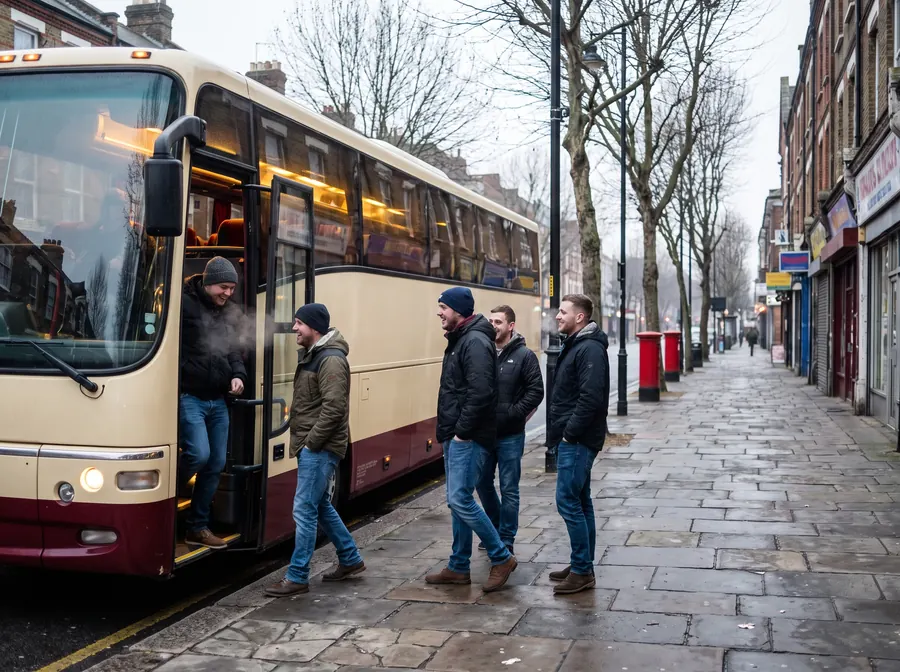
A cream and burgundy touring coach at the kerb by Powis Street in Woolwich on an overcast winter afternoon, a group of men in casual clothes boarding, wide pedestrianised street of Victorian and Edwardian buildings behind, bare trees and breath visible in the cold.
Powis Street, from the road that touches it The street in the background is pedestrian. Every vehicle photograph of “Powis Street” is really a photograph of the road at the end of it, and that is precisely the distinction we are describing: your group walks the last fifty metres, always.
Minibus versus coach

Eighteen height limits near Woolwich, and only six of them stop a full coach

Most lists of this kind give one figure for “a coach” and it is usually 4.4 m, which is a double-decker. A 49–53 seat single-deck touring coach is a good deal shorter than that: Mercedes-Benz lists the Tourismo, the commonest 49–53 seater on British roads, at 3.68 m including the roof air conditioning, and a 53-seat MAN Lion’s Coach at 3.87 m. We plan to 3.9 m, because we do not know which vehicle is free on your date until we allocate it. So there are three numbers here, not one: 2.8 m for a 16-seat minibus, 3.9 m for a full coach and 4.4 m for the 70-seat double-decker — and each of them draws a different map of the same borough.

Two honest caveats before the numbers. Only five of these eighteen roads are in the Royal Borough of Greenwich at all — the survey was taken on a radius, and it caught Bexley, Lewisham and, across the water, Newham. And the road called “Woolwich Road” is not in Woolwich. It is in East Greenwich, three kilometres west, where the A102 flies over it.

Four that stop a minibus as well as a coach

Roads near Woolwich with a signed height limit at or below 2.8 metres
RoadWhere it actually is LimitImperial From Woolwich
Martins Walk (tunnel) Abbey Wood SE28 · RB Greenwich 2.10 m6′10″2.8 km
Lynx Way Silvertown E16 · Newham, north bank 2.10 m6′10″3.3 km
Sainsbury’s access road Beckton E6 · Newham, north bank 2.10 m6′10″4.4 km
Antigua Mews (tunnel) Plaistow E13 · Newham, north bank 2.10 m6′10″5.6 km

Three of those four are on the far side of the Thames. They only ever become your problem if the route crosses — which, from Woolwich, a surprising number of routes do.

Eight a minibus clears, and only two of them stop a coach

Roads near Woolwich with a signed height limit between 2.8 and 4.4 metres, and whether each one stops a 3.9 metre coach or only the 4.4 metre double-decker
RoadWhere it actually is LimitImperial Effect
White Hart Road Plumstead SE18 · RB Greenwich · 2.2 km 3.30 m10′9″ Minibus only — no coach
Maran Way West Heath DA18 · Bexley · 4.8 km 3.60 m11′9″ Minibus only — no coach
Ennersdale Road Hither Green SE13 · Lewisham · 5.6 km 3.90 m12′9″ Coach level with the sign — no decker
Peartree Way East Greenwich SE10 · RB Greenwich · 3.2 km 4.00 m13′1″ Coach by 10 cm — no decker
Woolwich Road (not in Woolwich) East Greenwich SE10 · RB Greenwich · 3.1 km 4.00 m13′1″ Coach by 10 cm — no decker
Riverside Charlton Riverside SE7 · RB Greenwich · 2.8 km 4.20 m13′9″ Coach clears — no decker
Felixstowe Road West Heath SE2 · Bexley · 4.2 km 4.20 m13′9″ Coach clears — no decker
Dockside Road Silvertown E16 · Newham, north bank · 3.1 km 4.30 m14′1″ Coach clears — no decker

And six more where the double-decker is on the margin

Six further roads in the survey are signed between 4.4 m and 4.57 m. A 53-seat coach goes under all six with half a metre to spare and never needs to think about them. The 70-seat double-decker is the vehicle on the margin here: at 4.4 m it is exactly level with the three lowest of them and has seventeen centimetres at the highest. They are Central Avenue in Welling and Station Road in Blackfen, both Bexley; St Mildred’s Road in Hither Green, a tunnel, and Elmira Street in Ladywell, both Lewisham; and Creekside and Brookmill Road in Deptford. Not one of them is in the Royal Borough of Greenwich, and none is a road a Woolwich job would normally need. We list them because a margin of five centimetres is not a margin, and a driver should be told rather than surprised.

Road heights from OpenStreetMap contributors, ODbL, with each location checked against its own coordinates rather than assumed to be local. Signed limits change — a driver trusts the sign over any list, including this one.

Before you compare quotes

Woolwich is inside both the LEZ and the ULEZ

Woolwich is in the Royal Borough of Greenwich, which is Greater London, so both of Transport for London’s emissions zones reach it. Which one applies depends on the weight of the vehicle rather than what it is called:

  • Coaches and minibuses over 5 tonnes come under the Low Emission Zone. They must meet the Euro VI standard or pay £100 a day. They are not charged by the ULEZ.
  • Minibuses at or under 5 tonnes come under the Ultra Low Emission Zone, at £12.50 a day if they do not meet the standard.

Our vehicles are compliant, so there is nothing to pass on. It is still worth asking whoever else you are quoting: an operator running older stock in from Kent or Essex may be pricing a daily charge into your job without saying so, and Woolwich is close enough to the boundary that it happens here more than most places.

Charges, standards and boundaries are set by TfL and change. We confirm the position for the actual vehicle when we quote.

Their words, not ours

Where Woolwich groups go, and what those places publish

Four that put their coach and group arrangements in writing. Quoted as they wrote them, with the date we checked. We hold no arrangement with any of them — check before you book, because these things change.

Eltham Palace & Gardens

5.0 km · English Heritage · SE9 5NP

“Coaches can drop off next to the visitor centre before being advised where to park.”english-heritage.org.uk · checked 29 Aug 2026
“We offer a 10% discount for organised groups of 15 or more paying visitors when payment is made in a single transaction.”checked 29 Aug 2026

Free entry for one tour leader and one coach driver per group. The lift was out of service when we checked, so the upper floors were stairs only — worth a phone call if your group needs it.

Royal Armouries Museum

278 km · Leeds

“The Museum’s entrance is in Armouries Square 100 metres (approximately 110 yards) from the Museum’s accessible parking spaces, coach park, and drop-off point.”royalarmouries.org · checked 29 Aug 2026

The obvious long day out from a town that made the guns: the national collection of arms and armour, with a coach park of its own.

Portsmouth Historic Dockyard

111 km · Hampshire

“Most national coach services to Portsmouth stop at the Hard Interchange, located right next to the entrance to Portsmouth Historic Dockyard.”historicdockyard.co.uk · checked 29 Aug 2026

Coach parking is arranged by email rather than published, so it needs doing in advance. The Woolwich pairing writes itself: the dockyard that survived, visited from the one that did not.

The Historic Dockyard Chatham

34 km · Kent

“For more details regarding group visits please contact our group sales department.”thedockyard.co.uk · checked 29 Aug 2026

Group terms are not published on the site, so they are agreed by phone or email first. Straight down the A2 — the closest of the great naval yards to Woolwich, and the one whose story runs alongside it.

Also run regularly from Woolwich

Canterbury74 km · Kent
Brighton76 km · East Sussex
Whitstable68 km · Kent
Dover96 km · Kent
Leeds Castle47 km · Kent
Chessington31 km · Surrey
Southend-on-Sea45 km · Essex
Cambridge80 km · Cambridgeshire

Distances are straight-line from Woolwich, to give you a sense of the day rather than to price it. Ask us for the real road time, which from this side of London is usually better than people expect going east and worse than they expect going west.

The fleet

Sizes we run out of Woolwich, smallest first

The three highlighted sizes are what this town asks for most. At roughly 2.6 to 2.8 metres they clear every one of the fourteen limits above 2.10 m — the eight in the second table and the six on the margin — including the two that stop a full coach, and they fit the residential streets around the square. A 49 or 53-seater at 3.9 m loses only those two. The 70-seat double-decker at 4.4 m loses twelve of the eighteen. Nothing on wheels clears the four barriers signed at 2.10 m, which is rather the point of listing them separately.

8
Minibus
12
Minibus
16
Minibus
19
Mini coach
24
Midi coach
33
Midi coach
49
Full coach
53
Full coach
70
Double-decker

Every job comes with a professional driver. Executive seating, wheelchair-accessible vehicles and school-spec minibuses are all available. On a Woolwich job the seat count is a routing decision as much as a capacity one: a group of fifty in one coach and the same fifty in four minibuses reach different parts of this borough, and not always in that order of speed.

The Thames at Woolwich · crossings

Three ways to drive across the river here, and the one that will not take a double-decker

A free ferry that takes the tallest thing we run, and a motorway tunnel four kilometres west that takes a 53-seater one way, both ways, and a 70-seat decker in only one of them. Which of those you use decides more journeys out of this town than anything else on this page.
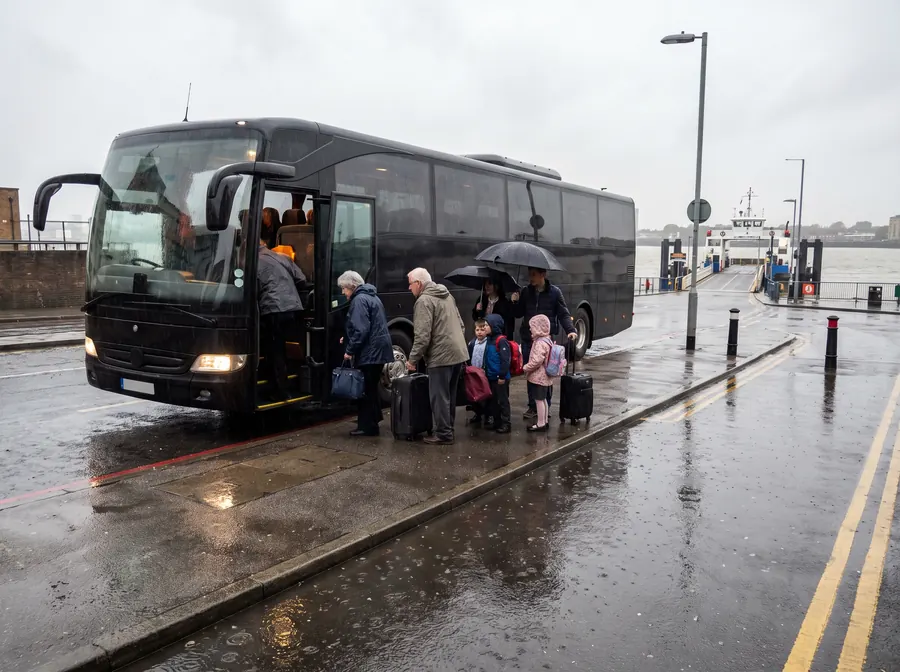
A black executive touring coach parked at the kerb on the approach road to the Woolwich Ferry terminal in steady rain, headlights on and umbrellas up, an extended family of grandparents and children boarding with suitcases, the wide Thames and a ferry beyond.
The ferry approach in the rain. Anything we run can board the Woolwich Ferry, up to the 4.4 m double-decker. Four kilometres west, in the northbound bore of the Blackwall Tunnel, that same decker would be turned back at the sign.

Every town has a constraint that shapes how vehicles move through it. In Croydon it is the tram track in the carriageway. In Wimbledon it is a fortnight in summer. In Woolwich it is the Thames, and unusually the constraint is not that the river is hard to cross. It is that the crossings disagree with each other about what a large vehicle is.

The free one, which takes the biggest vehicles

The Woolwich Ferry runs from a pier about seven hundred metres from the town centre. Transport for London operates it, and TfL is unambiguous on the two points that matter to a coach operator. First: “The ferry is free.” Second, the vehicle limits — maximum height 4.7 m and maximum width 3.5 m. A 49–53 seat touring coach stands about 3.9 metres and is 2.55 metres wide; the 70-seat double-decker is about 4.4. Both board with room to spare, and the decker is the only vehicle for which that is worth saying.

Since May 2024 the service has run a two-vessel timetable seven days a week, roughly 05:00 to 21:00, every fifteen minutes. Vehicles displaying Hazchem plates and anything on the Dangerous Goods List are refused. Dense fog stops the boats. Very high tides can too, though TfL says the service is not usually affected by tidal conditions.

The fast one, which only half does

About four and a half kilometres west, the Blackwall Tunnel carries the A102 under the river. It has two bores of very different ages, and TfL publishes a different height limit for each:

Height limits published by TfL for the driveable Thames crossings near Woolwich, and whether a 3.9 metre coach and a 4.4 metre double-decker clear each one
CrossingMax heightA 3.9 m coach?A 4.4 m decker?
Woolwich Ferry4.7 m (15′6″)Yes — and freeYes — and free
Blackwall Tunnel, southbound4.72 m (15′6″)YesYes
Blackwall Tunnel, northbound4.0 m (13′0″)Yes, by about 10 cmNo
Rotherhithe Tunnel2.0 m, 2 tonnesNo — not even a minibusNo
Woolwich foot tunnelPedestrians onlyNoNo

Read that table again, because the asymmetry is the point, and it is a decker problem rather than a coach problem. The northbound bore is the original, opened in 1897, and it is signed at four metres. A 70-seat double-decker cannot go north through it and must come back by the ferry, Silvertown or the A2. A 53-seater does fit — but by ten centimetres against our planning figure, which is why we treat the northbound bore as a decision rather than a default. London Buses settled the same argument long ago: route 108 has run single-deck through the Blackwall Tunnel since 1968 for exactly this reason. A driver who plans a round trip on the assumption that a tunnel works both ways has planned half a journey.

The Rotherhithe Tunnel is worse and less well known: two metres and two tonnes, which excludes a minibus, a Transit and most vans. It is a Victorian tunnel doing a modern job badly, and it is not a Woolwich option at all.

The new one, which is free for us and not for you

The Silvertown Tunnel opened on 7 April 2025, linking Silvertown to the Greenwich Peninsula alongside Blackwall. It is a charged crossing: a user charge applies at both Silvertown and Blackwall between 06:00 and 22:00, seven days a week, and the crossings are free overnight. TfL has said the charges rise from 21 September 2026.

But buses, coaches and vehicles with nine or more seats registered with the DVLA are exempt from the charge. So are Blue Badge holders, TfL-licensed taxis and recovery vehicles. For a 16-seat minibus or a 53-seat coach, Silvertown and Blackwall are free at any hour of the day. The tunnel also carries a proper bus service through it — the Superloop SL4 and an extended route 129 — which is a fair signal that it is built for large vehicles in a way the 1897 bore was not.

What that means when you book

Four things follow from all of the above, and they are the reason we ask which side of the river your day ends on before we quote.

A minibus has every option. At roughly 2.6 metres it clears the ferry, both Blackwall bores and Silvertown, and it is exempt from the tunnel charge if it is registered as nine seats or more. A full coach has every option too, on the numbers, though we route it round the 1897 bore rather than through it. A double-decker has three: the ferry, Silvertown, and Blackwall southbound only. An evening job needs planning, because the ferry stops around nine and a group that crossed on it at four in the afternoon is coming home through a tunnel. And a ferry-based plan needs slack, because a fifteen-minute service with a queue in front of it is not a fifteen-minute crossing.

None of this is exotic knowledge. It is signed, published and free to read. It is simply that an operator quoting Woolwich from thirty miles away has usually never had to know it, and will find out on your day rather than before it.